
Updated: June 10, 2026
Author: Alvin Villanueva, PMP®, PMI-ACP®; Editor: Geram Lompon; Reviewed by: Grace Payumo, PMP®
You’re one of thousands asking this exact question right now—and for good reason. While it may seem like a simple timeline issue, obtaining your PMP® certification depends on your experience, focus, and how you navigate the
Why the PMP® Journey Is a Game Changer for Your Career
Securing your credential transcends passing a standardized exam; it signals a definitive pivot toward adaptive leadership, prompting many practitioners to strategically evaluate whether the investment in certification yields measurable career growth.
The
It’s not just a badge, it’s a statement of your strategic value (PMI, PMP® Handbook, 2023).
Realistic PMP® Certification Timeline in Weeks
For most aspiring PMP® candidates, the PMP® certification process typically takes between 8 and 16 weeks, although this timeframe can vary.
Here’s a practical breakdown:
- Exam Eligibility Review and PMP® certification application: 2–3 weeks
- PMI Review: 5–10 business days
- PMP® exam preparation and study schedule: 6–12 weeks
- Scheduling and PMP® certification exam date: 1–2 weeks
If you need to log more
Start With Eligibility and Experience
Before applying, check the PMP® certification eligibility requirements. PMI looks at your education and experience managing projects:
- Bachelor’s degree: 36 months of
project management experience and 35 hours ofproject management education training or a Certified Associate inProject Management (CAPM®) credential - High school diploma or associate’s degree (or global equivalent): 60 months of experience and 35 hours of
project management education
If you’ve led projects over the past eight years, you may already meet the eligibility criteria (PMI, 2023).
Logging Your Project Management Experience the Right Way
Start by identifying the hours of
Your record should align with key
Submit Your PMP® Application With Confidence
Once you’ve gathered your hours and completed your training course, completing the PMP® certification requirement on the PMI website may only take a few hours. You’ll need to log:
- Contact and education details
- Hours of
project management per process group - 35 hours of formal
project management education
PMI usually responds in 5–10 business days. If selected for an audit, you’ll need to verify your experience. Adequate preparation helps streamline this application process (PMI, 2023).
Handling the PMI® Audit Like a Pro
If PMI selects your PMP® application for an audit, stay calm. Submit diplomas, supervisor signatures, and training documentation.
Most aspiring PMP® candidates clear this step within two weeks. Keeping track of your documentation from the start can make this phase quick and painless.
Building a Study Plan That Matches Your Lifestyle
The PMP exam covers the whole
Your exam preparation requires a well-planned study strategy backed by high-quality PMP® study materials to maximize your retention. Expect to spend 60–120 hours studying in total.
Whether you prefer mornings, weekends, or late nights, your success depends on sticking to a clear study schedule.
Study Methods That Work
There are many ways to complete exam preparation:
- Self-study using books, videos, or flashcards
- A structured PMP® training course
- Bootcamps (3–5 day immersion)
- Study group participation
- Taking practice exams and working with a coach
Choose what fits your lifestyle.
If you want structure and expert guidance, the ROSEMET PMP® Course Bundle offers a proven exam prep path, complete with 35 hours of education, realistic mock exams, and support tailored to your certification goals. Reviewing the core principles about ROSEMET training programs can give you a better understanding of our educational standards.
Why Taking Practice Exams Builds Confidence
Practice exams are crucial for preparing for the PMP® exam.
They simulate the exam format, test your knowledge under pressure, and pinpoint areas for improvement, which is exactly why utilizing a dedicated PMP® simulator has become an essential strategy for serious candidates.
Many PMP® certification holders credit mock exams with helping them pass the PMP certification exam.
To guarantee you hit this benchmark with maximum precision, upgrading your preparation by investing in our premium PMP® test simulator will drastically sharpen your situational decision-making and build unmatched exam endurance.
PMP® Exam Fee and Scheduling Your Exam Date
Once your PMP certification application is approved, you’ll pay your PMP exam fee:
- PMI members: $405
- Non-members: $555
PMI membership also gives you access to the PMBOK® Guide, exam prep forums, and professional development units (PDUs) post-certification.
After paying the exam fees, you can schedule your PMP exam at a Pearson VUE testing center or opt for a computer-based test online.
What to Expect From the PMP® Certification Exam Format
The PMP certification exam format consists of 180 exam questions, administered over 230 minutes.
Question types include multiple choice, matching, and hotspot scenarios. You’ll be assessed on:
- People: Leadership and team performance
- Process: Effective
project management techniques - Business Environment: Aligning projects with organizational strategy (PMI, 2023)
You’ll get your results instantly—and if you pass the PMP exam, you’ll officially become PMP certified.
How Long Does PMP® Exam Prep Take?
Depending on your availability and background in managing projects, exam preparation may take:
- Fast-track: 2–3 hours daily over 6–8 weeks
- Steady pace: 1–2 hours daily across 10–12 weeks
- Flexible pace: A few hours weekly, extending to 4–6 months
The time it takes to get PMP certified depends more on consistency than speed. With adequate preparation and regular review of study materials, you’ll stay on track.
One Candidate’s 90-Day Certification Journey
Take Anthony, for example. With a bachelor’s degree and formal
He studied two hours daily, took weekly practice exams, and passed the PMP certification exam in under 12 weeks.
Fast-Tracking vs. Time Traps in PMP® Prep
To shorten your journey:
- Follow a structured study schedule.
- Use high-quality study materials.
- Take regular practice exams.
- Join a study group or coaching circle.
- Focus on real-world scenarios, not just theory
To avoid delays:
- Don’t skip mock exams.
- Don’t delay submitting your PMP application.
- Avoid low-quality exam prep content.
- Stay consistent with your study schedule.
How to Simplify the PMP® Certification Process
Want a smoother experience?
- Start your application process early.
- Use official PMI resources and the PMBOK® Guide.
- Track your professional development progress.
- Choose a training course with built-in flexibility.
- Surround yourself with other project managers.
When you commit to exam preparation with the right tools, the PMP certification process becomes far more manageable.
Build Momentum, Not Just a Timeline
Instead of asking how long it takes to get PMP certification, focus on how to make steady progress. Build your foundation, create a learning rhythm, and celebrate weekly wins.
You’re not just earning a credential—you’re strengthening your
Get PMP® Certified—On Your Timeline
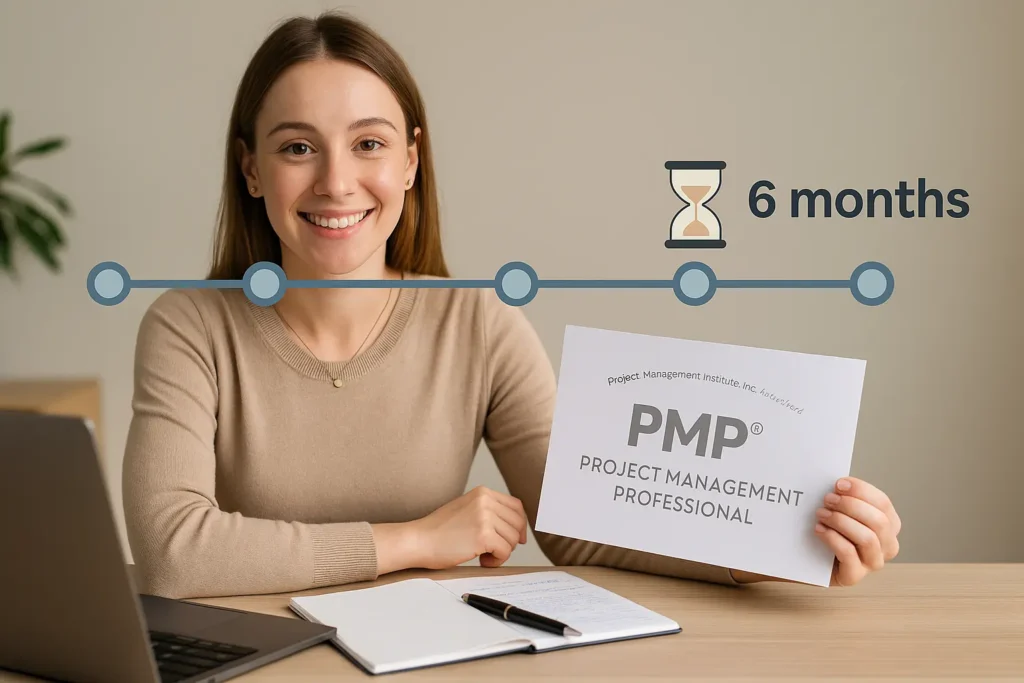
You don’t have to rush. You don’t have to wait either. Whether it takes 60 days or six months, passing the PMP exam proves you’ve got the discipline and knowledge to lead.
So the next step is simple: start your
References:
Project Management Institute. (2023). PMP Handbook. Retrieved from https://www.pmi.org/certifications/project-management-pmp
ROSEMET. (2023). PMP Course Bundle. Retrieved from https://www.rosemet.com/pmp-certification/