
Updated: June 07, 2026
By: Hajime Estanislao, PMP®, CSM®; Editor: Geram Lompon; Reviewed by: Alvin Villanueva, PMP®, PMI-ACP®
Are you building the right features or only building them right?
Teams often work at high velocity and release quickly, iterating frequently, and still struggle to align their output with what users truly need. Despite having Agile workflows in place, delivery can still feel disconnected from real-world value.
While foundational Agile frameworks emphasize collaboration and iterative delivery, successfully bridging the value gap requires advanced leadership—a core competency for professionals leveraging structured PMP® certification training to synchronize continuous feedback with strategic business objectives under 2026 PMI® standards.
If feedback only arrives at the end of a sprint, or worse, after launch, it is already too late to adapt.
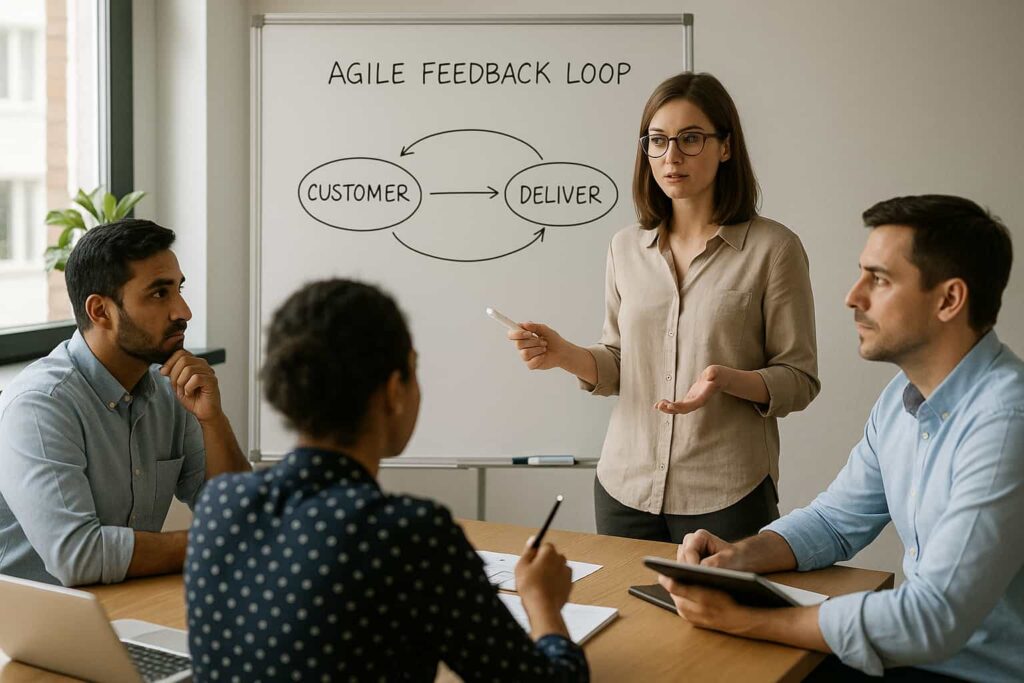
A customer-centric delivery model powered by intentional Agile feedback loops, providing teams with a clear and consistent view of what matters most: the user. An agile feedback loop is an iterative process that enables teams to continuously gather and act on user feedback, enhancing product quality and user alignment.
In this episode, we will discover the principles behind customer-centric delivery and how to build Agile feedback loops that close the distance between users and teams.
What are Customer-centric Delivery and Agile Feedback Loops?
Customer-centric delivery is an approach that places users’ goals, behaviors, and frustrations at the center of the development process. It shifts the definition of success from internal milestones to meaningful customer outcomes such as reduced friction, improved satisfaction, and real-world usability.
Rather than shipping features and measuring adoption later, teams work to validate whether what they’re building matches the needs of real users from the start.
At the same time, it is essential to ensure that product development is aligned with broader business needs so that the product delivers value and supports organizational objectives.
Example 1:
A product team behind a mobile banking app noticed a recurring complaint through app store reviews and in-app surveys: delayed transaction alerts. Product teams are crucial in gathering and acting on user feedback to address customer and business needs.
By analyzing this user feedback, the team prioritized revamping the notification system. The result? Faster alerts, fewer complaints, and a measurable improvement in user trust and satisfaction.
Agile Feedback Loops: Closing the Gap Between Teams and Users
Agile feedback loops provide the mechanism for continuous learning. These loops gather insights throughout development, not just at the end, and feed them into planning, decision-making, and execution. They help Agile teams avoid building in isolation, reduce waste, and improve alignment with evolving expectations.
Example 2:
A Scrum team working within the Scrum framework, which structures development into sprints and feedback loops, runs a sprint review every two weeks. During these sessions, working software is presented to stakeholders and a select group of users. Their input influences both the prioritization of the backlog and refinements to in-progress features.
The scrum master plays a key role in facilitating these feedback loops and ensuring continuous improvement within the team. This ongoing conversation ensures that the next sprint is more informed, focused, and valuable.
Reasons for Customer-centric Delivery
Today’s users are more informed, selective, and vocal than ever. Building without their input is a gamble, especially in competitive markets.
Customer-centric delivery gives teams the context to create features that resonate, not just release on time.
- Grounds development is based on real user needs rather than internal assumptions.
- Minimizes the effort spent on underused or irrelevant features
- Increases customer engagement and user retention by delivering what matters
- Builds transparency and trust with business users and stakeholders, improving the overall customer experience
- Encourages cross-team collaboration aligned around user outcomes, with leadership support crucial for driving meaningful changes in customer-centric initiatives
- Anchors roadmap decisions in customer feedback instead of gut instinct
- Keeps teams laser-focused on the core tenets of value-driven delivery, ensuring that product iterations prioritize tangible user outcomes over simple administrative progress tracking.
Reasons for Agile Feedback Loops
In Agile, speed without feedback is just motion. Feedback loops make the difference between busy teams and high-impact teams.
They turn ideas into validated outcomes and promote smarter delivery with every iteration.
- Enable continuous improvement through real-time course correction by quickly acting on feedback received, which accelerates learning and iteration.
- Shrink the delay between delivery and learning.
- Surface risks and usability issues before they escalate
- Encourage openness and shared ownership across the entire team.
- Turn raw input and the feedback gathered from various sources into actionable insights.
- Help teams remain responsive to change without losing focus.
- Reinforce quality through ongoing dialogue with end users by gathering valuable feedback that informs continuous improvement.
Vision and Clarity: Setting the Direction for Customer-centric Agile
A strong, customer-centric vision is the foundation of any successful Agile initiative. The development process becomes more purposeful when the entire team understands and rallies around a clear business objective.
The vision should be specific, easily communicated, and deeply rooted in delivering value to customers, not just meeting internal milestones. By setting a clear direction, teams can focus on what truly matters: solving real user problems and driving continuous improvement.
A well-articulated vision helps teams prioritize feedback, align their work with business objectives, and ensure every iteration moves the needle on customer satisfaction. It promotes a culture where user feedback is welcome, actively sought out, and integrated into the process.
The team can make informed decisions that consistently deliver value when vision and clarity are present. This alignment keeps everyone moving in the same direction, accelerates the feedback process, and ensures that customer needs remain at the heart of every release.
Leadership: Guiding Teams Toward Customer Value
While effective leadership is the ultimate driving force behind teams that consistently deliver value, initiating a risk-free 7-day trial of our comprehensive PMP® certification training provides the expertly structured curriculum required for modern project managers to formally master those agile methodologies and systematically champion a culture of continuous improvement.
Leaders set the tone by championing a culture of continuous improvement and prioritizing customer needs at the forefront of every decision they make. They provide the support, resources, and guidance necessary for teams to experiment, learn, and adapt quickly.
A customer-centric leader empowers team members to collaborate openly, encourages feedback sharing, and ensures that data-driven insights inform the development process.
By fostering an environment where feedback is valued and acted upon, leaders maintain teams with high-quality standards and become responsive to changing customer expectations.
Strong leaders are willing to listen to both their teams and their customers. They adapt strategies based on real-world data, aligning the team’s efforts with delivering maximum value.
In doing so, they help Agile teams meet business goals and exceed customer expectations, driving both satisfaction and business growth.
Step-by-Step: Building Agile Feedback Loops
Creating a feedback loop is not about collecting more opinions but about designing intentional systems that help teams act on what they learn.
Defining processes for gathering and acting on feedback is relevant to ensure insights are consistently captured and effectively used.
Here’s how to build loops that keep delivery aligned with users and grounded in data.
Step 1: Identify Key Feedback Sources
Feedback should be purposeful and not overwhelming. Start by identifying which voices matter at each stage of the product lifecycle. It could include early adopters, customer success teams, internal stakeholders, or external business users. Involve the target user in usability testing and feedback collection to ensure the collection of relevant and actionable insights. Teams should research and gather data from these key user groups.
Map out high-value touchpoints where feedback naturally emerges, such as beta programs, support tickets, NPS responses, or community forums. Then, decide what kind of feedback (quantitative or qualitative) will be most useful and where you will collect it.
Step 2: Choose Tools for Collecting and Managing Feedback
Great tools don’t just capture feedback; they structure it. Modern platforms also facilitate efficient data collection across multiple channels, making it easier to gather customer feedback from various touchpoints. The right stack enables teams to surface trends, connect responses to development, and prevent losing valuable insights in spreadsheets or email inboxes.
Utilize platforms or customer service integrations to streamline collecting data for analysis and actionable insights. Link these to backlog tools when needed and apply natural language processing to categorize and analyze open-ended responses at scale.
Step 3: Integrate Feedback into the Development Workflow
Collecting feedback without action creates frustration. Embed it into planning, refinement, and review ceremonies so that it naturally guides team decisions. This integration is essential for modern software development practices, enabling teams to remain agile and responsive to change.
During sprint planning, have the product owner present themes from recent feedback. Adjust backlog priorities accordingly. Encourage scrum masters to make feedback discussion a recurring topic in retrospectives.
Step 4: Act on Feedback with Transparency
Acting on feedback builds credibility. When users see their input turn into action, they’re more likely to keep sharing, creating a healthy feedback culture.
Publish changelogs, host brief customer demos, and acknowledge the sources behind product updates. Internally, highlight which feedback threads led to which backlog updates. Celebrate responsiveness as much as velocity.
Step 5: Measure the Impact and Iterate
Feedback loops should evolve as your product and user base grow. Regularly assess whether the loop captures the right insights and leads to the desired outcomes. Monitor the time spent on feedback-driven changes and ensure the improvements justify the investment.
Check that the features inspired by feedback are achieving their goals. Use data-driven follow-up (support volumes, sentiment, usage metrics) to validate decisions. Refine your tools, sources, or cadence as needed.
Role of Artificial Intelligence in Feedback Loops
Artificial intelligence revolutionizes how teams gather, analyze, and respond to customer feedback. By leveraging AI-powered tools, development teams can automate the feedback process, making it easier to collect actionable insights from vast amounts of data.
Natural language processing (NLP) and machine learning (ML) algorithms can sift through customer feedback, online reviews, and user behavior data to identify trends, sentiments, and emerging needs.
AI enables teams to process feedback at scale, uncovering unusual patterns through manual analysis. It allows faster and more accurate identification of areas for improvement and helps teams prioritize changes that will significantly impact customer satisfaction. With AI, feedback loops become more efficient and data-driven, empowering teams to make informed decisions and drive continuous improvement.
By integrating artificial intelligence into feedback loops, businesses can stay ahead of customer expectations, deliver more relevant solutions, and ensure that every iteration adds value. The result is a more intelligent and responsive development process that keeps customers at the center of every decision.
Best Practices for Customer-centric Delivery and Feedback Loops
To truly excel at customer-centric delivery and build effective feedback loops, Agile teams should embrace a set of proven best practices:
- Prioritize User Research and Customer Feedback: Make gathering feedback from real users a core part of your product development process. Utilize interviews, surveys, and analytics to understand customer needs and pain points.
- Establish Continuous Feedback Loops: Don’t wait for the end of a sprint or release—collect feedback at regular intervals and integrate it into every stage of development. It ensures that new data and insights are informing your next steps.
- Leverage Agile Methodologies and Iterative Development: Use frameworks such as Scrum or Kanban to deliver working software quickly, test ideas, and refine features based on customer input.
- Harness AI and Machine Learning: Use advanced tools to analyze customer feedback and behavior, turning raw data into actionable insights that guide product decisions.
- Foster a Culture of Collaboration and Continuous Learning: Encourage open communication, experimentation, and knowledge sharing across teams. Make continuous improvement a shared goal, and celebrate learning as much as delivery.
Consider Feedback Loops in Enhancing Delivery
Feedback loops are not just mechanisms for retrospectives but also catalysts for smarter delivery. They bridge the gap between product vision and actual user experience when applied consistently. Feedback loops enable teams to understand and improve customer experiences throughout the journey. They give development teams the insight needed to shape resonant features and scale solutions that stick.
A strong loop also breaks down silos. It ensures that sales teams, designers, engineers, and product management are aligned around shared input and not working from different assumptions. Over time, this collaboration fuels momentum, improves prioritization, and reduces misfires.
Feedback loops reinforce a culture of continuous learning. Whether through lightweight A/B tests or deep dives powered by machine learning, the best teams treat every cycle not just as a chance to ship but as an opportunity to validate and refine an idea based on user input.
Final thoughts: Customers Providing Feedback – It’s Not a Dream
Collecting useful, regular customer feedback is not wishful thinking; it is achievable, repeatable, and incredibly impactful. By weaving agile feedback loops into your customer-centric delivery practices, your team builds a direct connection to the people using your product and the problems they want to be solved.
As Agile frameworks evolve, the ability to listen and adapt becomes just as important as speed. Feedback is not a checkpoint at the end but a resource that should shape every sprint. With the right tools, a collaborative mindset, and a structured process, teams can transform feedback from a loose suggestion into a competitive advantage.
The opportunity is real, and so are the results.
References
Alliata, Z., & Eckstein, J. (2025, April). Working towards sustainable AI development using Agile methods. Georgetown University School of Continuing Studies. Retrieved from https://scs.georgetown.edu/news-and-events/article/9953/working-towards-sustainable-ai-development-using-agile-methods
Komandla, V. (2022). Enhancing product development through continuous feedback integration. ESP Journal of Engineering & Technology Advancements, 2(4), 105–115. https://doi.org/10.56472/25832646/JETA-V2I4P118
Boylan, L. (2020, March). Closing the feedback loop. UX Collective. Retrieved from https://uxdesign.cc/closing-the-feedback-loop-f061c14dce62
Heusser, M. (2019, January). 6 ways to tighten Agile feedback loops. TechTarget. Retrieved from https://www.techtarget.com/searchsoftwarequality/tip/6-ways-to-catch-defects-in-software-tighten-feedback-loops